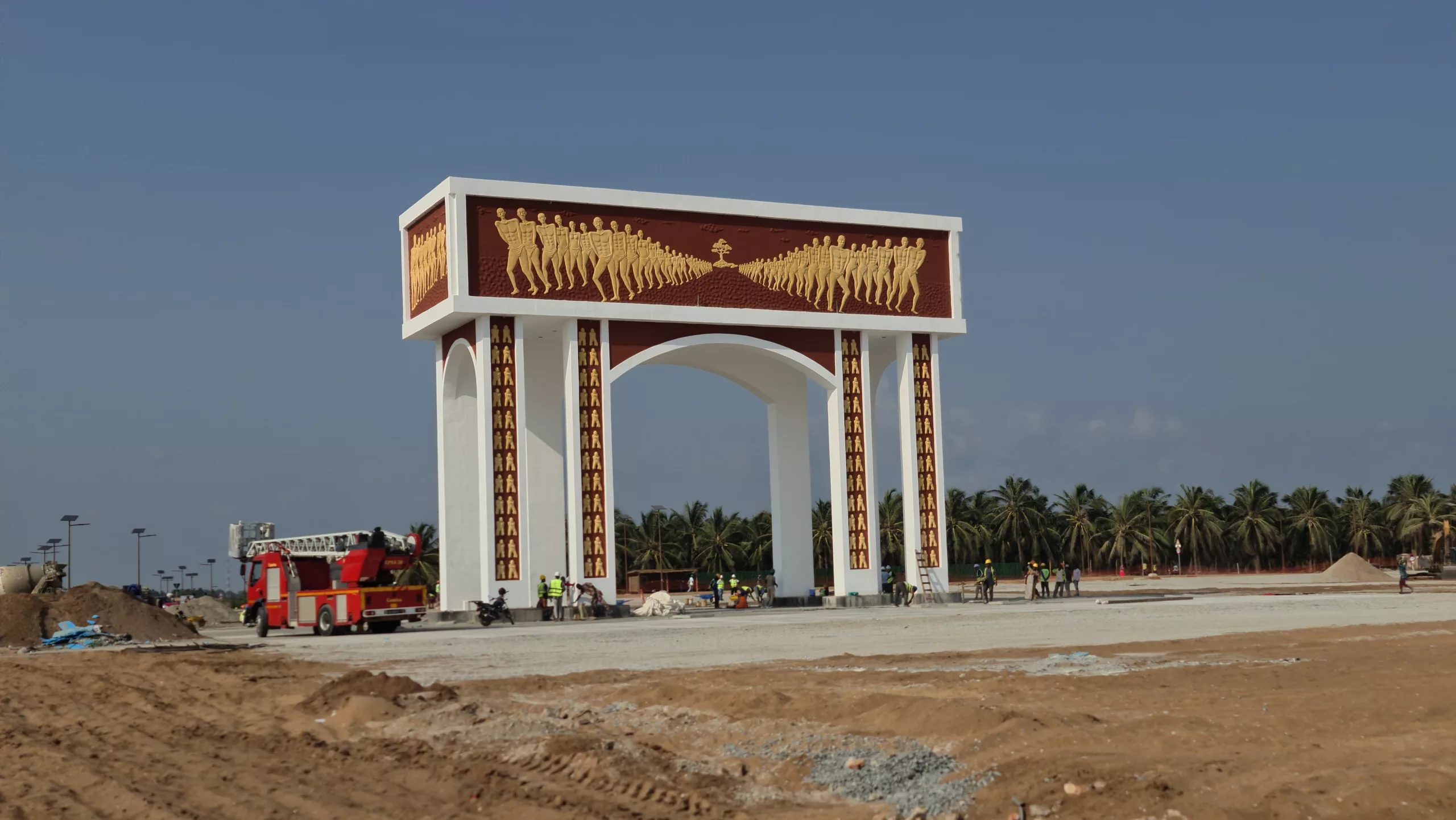
Porto-Novo is a popular day trip from the city of Cotonou.
For a long time, I thought about spending a few nights there.
However, since I really wanted to have a base in the region, I decided it would be better to stay in Cotonou and visit Porto-Novo in just one day.
A friend who works in tourism recommended a guide to explore the city, and I absolutely don’t regret it. The tour was extraordinary!
I enjoyed the city so much that I’d love to go back—not only to explore more, but also to stay a few nights and soak up its atmosphere.
When you research Porto-Novo, you’ll probably get the impression that there isn’t much to see. That’s not true. The city has far more to offer than it seems!
So here are 11 things do in Porto-Novo Benin, according to someone who’s seen the essentials!
This article contains affiliate links 🙂 They earn me a small commission on bookings, but no worries—there’s no extra cost to you. Thanks for supporting my blog!
Plan Your Stay in Porto Novo in Just a Few Seconds!
In a rush to plan your trip? This mini-guide has all the essentials you need!
Located in southeastern Benin, about thirty kilometers from Cotonou, Porto-Novo is the country’s administrative capital.
Unlike the image we often have of a capital city, it is peaceful and laid-back.
It stretches along a lagoon connected to the ocean, surrounded by mangroves and quiet residential neighborhoods with calm streets.
Founded in the 17th century by the Adja people before becoming the capital of the Kingdom of Adjatchè, Porto-Novo quickly developed trade ties with Portuguese merchants—hence its name, which means “new port.”
The city also took part in the slave trade networks, serving as a trading and transit point in the Atlantic trade.
In the 19th century, Porto-Novo placed itself under French protectorate to protect against the ambitions of the Kingdom of Dahomey, before becoming one of the colony’s main administrative centers.
Today, Porto-Novo is an important political and cultural hub. It charms visitors with its heritage, museums, and atmosphere.
Like Ouidah, Porto-Novo maintains a deep connection to Vodun, an ancestral religion that is still very much alive in the region.
Here, traditions naturally coexist with Christianity and Islam, reflecting Benin’s spiritual diversity.
11 things to do in Porto-Novo Benin
1. Visit the royal palace
I started the tour with one of my favorite places: the Royal Palace. The former residence of the kings of Adjatchè reflects the city’s monarchical past.
You can visit it with a guide who will reveal the secrets of its many rooms.
You’ll also learn more about the history of the site, the Vodun religion, and some political anecdotes.
Taking photos inside the grounds is not allowed. In any case, I 100% recommend this visit.
2. Admire the Zangbeto Headquarters
The Zangbeto Headquarters is a temple dedicated to one of the most mysterious figures in Vodun.
The Zangbeto are “guardians of the night,” masked entities who symbolically ensure the protection of neighborhoods.
Their headquarters in Porto-Novo reflects the importance of their spiritual and social role, which remains active to this day.
3. Take your time at Abessan square
Abessan Square was the highlight of my visit to Grand-Popo. My guide handed me over to another lovely guide who told me the legends surrounding the construction of the impressive Abessan Temple, which looks like a massive termite mound rising from the earth.
She then guided me through the area where the walls are covered with 3D mosaics that visually depict those legends. You don’t just hear the story—you actually see it come to life before your eyes.
4. Stroll through the market
The Grand Market of Porto-Novo is an incredibly lively space where hundreds of people move about every day.
Here you can find everything: stalls with fruits, vegetables, spices, colorful fabrics, and mysterious objects used for rituals.
It’s a magical place to observe the local energy. Avoid taking photos.
Next to the new mosque stands a much more charming monument: the Great Mosque of Porto-Novo.
Built in the early 20th century by Afro-Brazilians returning from Brazil, it surprises with its unique architecture inspired by Afro-Brazilian style.
Its appearance immediately catches the eye: with pastel-colored façades, ornate balconies, and elegant lines, it resembles a baroque church more than a traditional mosque.
6. Visit the Cathedral of Our Lady of the Immaculate Conception
Another major religious monument, the Cathedral of Our Lady of the Immaculate Conception, was built during the colonial period.
Its architecture is simple yet colorful, illustrating the harmonious coexistence of religions in the city.
7. Visit the Black and African pantheon
For anyone who wants to learn more about the history of Africans and Afro-descendants, a visit to the Pantheon is a must.
This symbolic place highlights the struggles, achievements, and cultural legacies of Africa. It invites broader reflection on Black history and identity around the world.
There is also an entire room dedicated to the most famous Africans who have left their mark on history in one way or another.
8. Pass by Toffa square
Toffa Square is dedicated to King Toffa I, an important figure in local history who signed the protectorate treaty with France at the end of the 19th century.
At the center of the square stands the king’s massive statue.
Unfortunately, it was covered for renovations during my visit, so I don’t have any photos.
Join the interest list for the Benin trip in winter 2026–2027!
Thank you for your interest!
This travel project is still in the planning stage. The idea is to build a meaningful experience, in a small group, for the winter of 2026–2027.
9. Walk through the colonial neighborhood
The Colonial District of Porto-Novo is a historic area centered around 19th- and 20th-century buildings.
It is notable for the Governor’s Palace, now the National Assembly, the African Heritage School, and ochre-colored houses whose architecture was influenced by French colonists.
Since many of the buildings are now used for administrative purposes, my guide advised me not to take any photos.
10. Look for the climate sentinels
Walking along the lagoon is extremely pleasant thanks to the various boardwalks that allow you to move around without harming the many plants and trees that live there.
The scenery, with the ocean in the distance and a gentle breeze, adds an extra touch to this peaceful stroll, dotted with “sentinels.”
The Climate Sentinels are a series of sculptures created by contemporary Beninese artists.
They are often accompanied by flood gauges to raise visitors’ awareness of flood risks related to climate change.
11. Sail on the Black River
The Black River, which flows through the Porto-Novo lagoon, offers a peaceful natural setting.
It is explored by canoe to observe the mangroves and local fishermen.
For instance, I was able to take part in a pottery workshop and another on basket weaving.
My guide also took me to a village where women were preparing palm oil and producing sodabi, the local liquor.
When to go to porto-novo?
Like the rest of southern Benin, Porto-Novo enjoys a warm tropical climate year-round.
The most pleasant period is from November to March, during the main dry season.
The rainy season, from April to July and again in September-October, makes the vegetation lush but can complicate travel, especially due to the many dirt roads.
If you want to experience the country’s cultural and spiritual richness, January 10th, Vodun Festival Day, is a particularly interesting time throughout southern Benin.
If traveling in winter isn’t possible for you, August is another month worth considering.
How many days to stay in porto-novo?
Most tourists visit the city on a one-day trip, which allows you to see the essentials.
However, after seeing it this way, I recommend spending 2 days there to explore as many sites as possible while taking the time to understand their cultural significance fully.
I’m sure you’ll be charmed by the atmosphere, so if you enjoy traveling slowly—observing life around you, meeting local people, and savoring local dishes—why not spend 3–5 days in Porto-Novo?
How to get to Porto-Novo from cotonou?
From Cotonou, Porto-Novo is about 30 km to the east. The trip takes between 45 minutes and 1 hour 30 minutes, depending on traffic. Several options are available:
Shared taxi: as always, this is the most economical option. Make sure to ask locals where to catch it, as it can be a bit tricky for tourists.
Taxi: for more comfort. You can flag them down on the road or book a private car via the Gozem app.
Moto-taxi: this is how I got to Porto-Novo. The ride is long, so you should be comfortable on a motorcycle.
Local minibuses: they run regularly between the two cities. This was the option I chose for the return trip, but without my guide helping me buy a ticket, I really don’t think I would have figured out how the system worked.
BOOK A PRIVATE DRIVER FROM COTONOU
This can be an interesting option. It allows you to skip the haggling and have a direct transfer from your accommodation. Prices remain reasonable, especially if you share the cost with others.
As in the rest of the country, it’s important to travel in Porto-Novo with an eco-responsible mindset.
This means:
Choosing local guides for your tours
Supporting local artisans and merchants
Always asking permission before photographing people or religious ceremonies
Not intruding on any ceremony
Picking up your trash
Being mindful of your water usage and waste
Respecting local wildlife and plants.
Of course, these are just a few key actions, but there are many more!
I hope this article helps you plan your next visit to this wonderful city, which I hope to explore again soon. Leave any questions you have in the comments.