Things to Do in Cotonou
Porto-Novo is the official capital of Benin, the city that draws all the attention is Cotonou.
This is where economic and cultural life is in full swing, and it’s also where you’ll land when you arrive in the country.
Cotonou naturally becomes the first stop for most trips to Benin.
It’s also an excellent base for getting a feel for the country, observing a way of life different from ours, and easing yourself into it.
The city is also a strategic starting point for visiting Porto-Novo, the Black River, or even the lakeside village of Ganvié.
But let’s be honest: Cotonou is a noisy, chaotic city where traffic seems to never stop.
Yet behind this constant buzz, it also hides peaceful streets, neighborhoods where everyone greets each other, and small oases where you can relax and recharge.
So, enough talk. Let’s take a look at 12 things to do in Cotonou during your stay.
This article contains affiliate links 🙂 They earn me a small commission on bookings, but no worries—there’s no extra cost to you. Thanks for supporting my blog!
Plan Your Stay in Cotonou in Just a Few Seconds!
In a rush to plan your trip? This mini-guide has all the essentials you need!
WHERE TO SLEEP?
- Guest House Étoile (ideal for solo travelers)
- ÉLIA Résidence (recommended for couples)
WHAT TO VISIT?
- Take a photo of the Amazon
- Admire the Heritage Wall
- Take a trip to Ganvié
- Visit Porto-Novo
WHERE TO EAT?
- Saveurs du Bénin (to try a wide variety of local dishes)
- Café Étoile Bénin (for a coffee break or brunch)

TABLE OF CONTENTS
Cotonou in a nutshell
Cotonou is the economic, political, and cultural heart of Benin, located between the Atlantic Ocean and Lake Nokoué.
Originally, Cotonou was a small fishing village, and its name is believed to come from the Fon expression “Kútɔ̀nú,” meaning “near the river of death,” referring to the once-feared waters of the region.
Colonized by France, the country gained independence in 1960, and Cotonou became the country’s main administrative and economic hub.
Today, Cotonou is home to the autonomous port, the true economic lifeline of the country, and it also hosts most of the major political institutions, businesses, embassies, and key infrastructure.
12 things to do in Cotonou
1. Get lost in Dantokpa Market
Dantokpa Market is an experience in itself, but I definitely don’t recommend going there alone.
As a tourist, you’ll be approached constantly. On top of that, it’s extremely crowded. The atmosphere can quickly become overwhelming.
You can find absolutely everything here at very good prices: food, fabrics, utensils, electronics, traditional medicine…
I recommend going during the day and with a local or a guide if it’s your first visit.
It’s not the ideal place to wander around for hours, but it’s an almost essential stop to understand the city truly.
Please don’t take photos. It’s a sensitive issue in Benin, especially in markets.
If someone thinks you’re taking their picture—even if you’re not—it can quickly lead to a small argument.
2. Enjoy Fidjrossè Beach
Fidjrossè Beach is a place where you can truly slow down.
Although swimming can be dangerous depending on the currents, the beach is still perfect for walking, sitting in front of the ocean, or having a drink at sunset.
It’s also a lively spot for locals: families, street vendors…
I recommend coming before sunset to enjoy the beach, then sitting down at one of the bars to sip a cold beer surrounded by locals.
Are you planning your trip to Benin?
Check out my most popular articles:
👉 12 Things to Know Before a First Trip
👉 SIM Card or eSIM in Bénin?
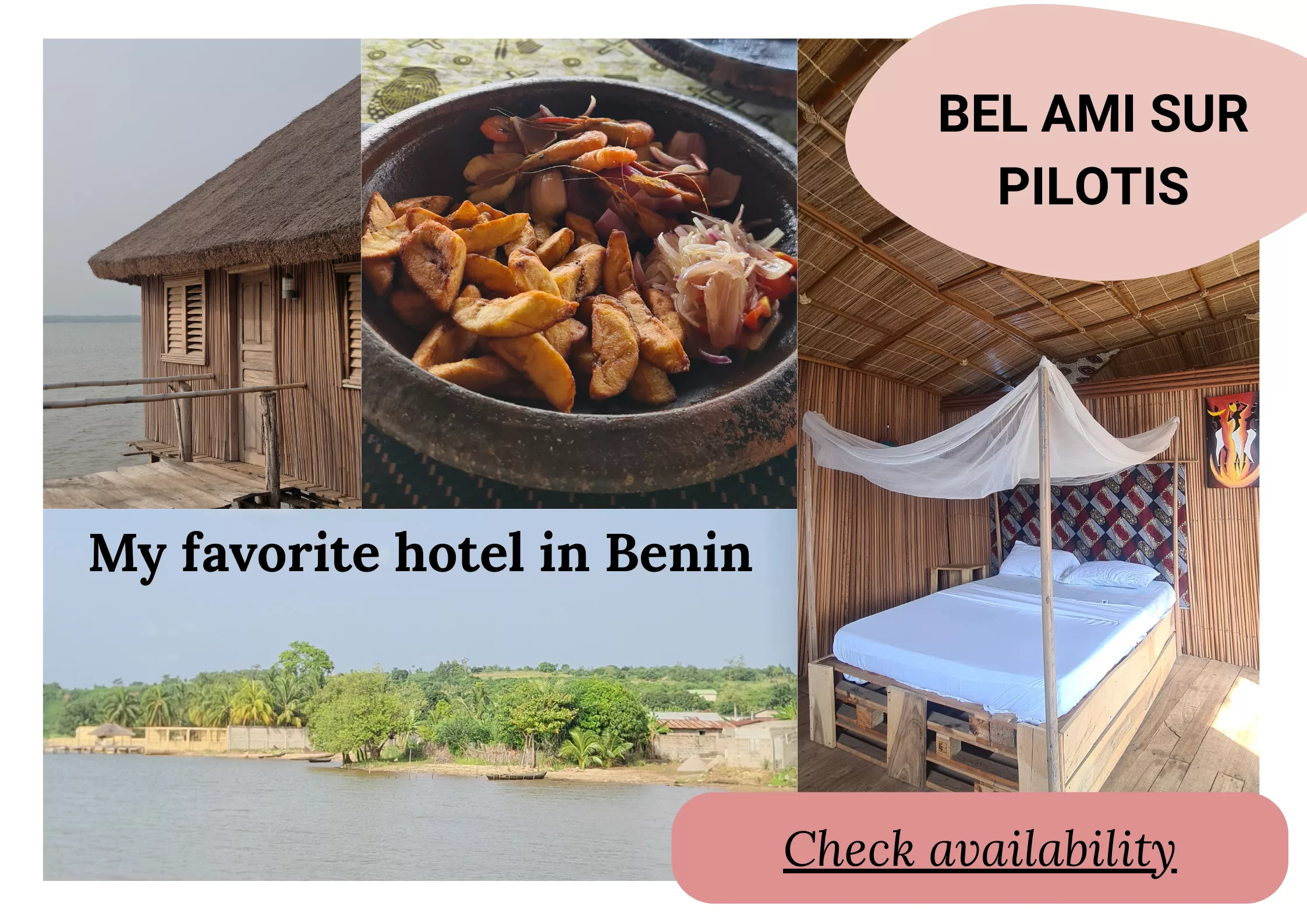
👉 My Favorite Hotels in Benin?
👉 What to Do in Ouidah?
3. Meet the Amazon
It’s the city’s iconic monument! The imposing Amazon statue is one of the tallest on the continent.
Standing 30 meters high, it dominates its surroundings and immediately draws the eye, whether you’re on foot, on a motorbike, or stuck in traffic.
The statue honors the Amazons of Dahomey, the warrior women who were part of the precolonial kingdom’s army and held a unique place in Benin’s history.
It’s not meant as just a tourist attraction, but as a powerful symbol of memory, pride, and historical heritage.
It’s also a very popular meeting spot, especially for young people.

4. Admire the Patrimoine Wall
The Heritage Wall runs along the city’s port and is made up of dozens and dozens of graffiti, all equally beautiful.
Each one represents Beninese heritage in its own way. You can admire historical figures, traditional symbols, and even scenes from daily life.


5. Shop at the Arts Market
If you’re looking for souvenirs, the Arts Market is a good alternative to the more chaotic markets, even though prices are higher.
Sculptures, masks, jewelry, textiles… the items are very diverse.
Personally, I didn’t enjoy this place. Every artisan stopped me, trying to get me into their shop.
I think I stayed there only 5 minutes before leaving. Too overwhelming for me!
Still, I recommend going, because there are some really beautiful pieces.
6. Go to Étoile Square
Known by everyone in Cotonou, Star Square is located at a strategic intersection in the city.
Historically, this square has long been associated with large public gatherings, protests, and key moments in the country’s political life.
It has been the scene of many significant events, especially during periods of political transition, making it a place full of historical memory for the Beninese people.
Even today, Star Square remains a central hub: banks, shops, restaurants, and major traffic routes all intersect there constantly.

7. Visit the Martyrs' Square
Martyrs’ Square is a symbolic place, full of history.
It honors those who shaped the country’s history and serves as an important space of memory for the Beninese people.
It’s not a long visit, but you can admire the sculpture.
Unfortunately, I couldn’t do so, as it was under renovation when I was in Cotonou.
8. Take a bike tour
If you’re traveling solo and don’t feel like exploring the city alone, this electric bike guided tour might interest you.
Heritage Wall, Star Square, Amazon Statue… you’ll pass by all the city’s most iconic spots, and your guide will share all their secrets with you.
9. Try the local cuisine
Beninese cuisine is richer than you might think! There are plenty of dishes to try.
I recommend grilled fish, pounded yam with peanut sauce, eba, boniwo sauce, and allocos… The dishes are simple but full of flavor.
I suggest trying both restaurants and small local eateries, just by observing where the locals eat.
Here’s a restaurant I visited regularly during my stay, offering a wide range of dishes!


10. Take a trip to Ganvié
Located just a few kilometers from Cotonou, Ganvié is the famous stilted lake village.
The visit is done by pirogue from the dock and allows you to discover a unique way of life, entirely organized around the water.
It’s one of Benin’s most famous excursions, and even though it’s touristy, it remains extremely interesting.
I recommend going with a local guide to better understand the village’s history and to avoid going alone, as the excursion can be quite expensive.
Try finding other travel partners at your hotel, for example.

11. Explore the Rivière noire
The Black River is a mystical river that is central to the local people.
For travelers, it’s a timeless escape, to be explored by pirogue, far from the hustle and bustle.
Surrounded by dense vegetation and complete silence, you move along to the rhythm of your captain’s bamboo pole, gliding the pirogue over the dark water.
Your guide reveals the secrets of this magical place.
Depending on the tour, the experience can be enhanced with several activities: tasting sodabi, learning how palm oil is made, a clay workshop, or an introduction to basket weaving.
For my part, I was lucky to do this excursion with an absolutely exceptional guide, and the Black River is definitely one of my most beautiful memories of Benin.


12. Take a trip to Porto-Novo
Porto-Novo, the capital of Benin, can easily be visited in a day from Cotonou. Quieter, it offers a very different atmosphere.
I highly recommend exploring it with a guide rather than on your own, as you’d miss truly magical places full of history and symbolism.
You can admire must-see religious monuments like the old mosque, take a tour of the Black and African Pantheon, and learn more about voodoo by visiting strategic and fascinating sites.


Can you travel solo in Cotonou?
Yes, it’s perfectly possible to travel solo in Cotonou.
But I, who constantly travel alone, wouldn’t recommend it to everyone.
Personally, I didn’t always feel comfortable walking alone.
Clearly, it was obvious I was a tourist, and everywhere I went, eyes were on me. Which is completely normal!
I want to emphasize that I never felt unsafe. EVER.
However, this constant attention, which never let up during my trip, was hard to handle and mentally a bit exhausting.
To avoid this, I recommend using moto-taxis and staying in a quiet neighborhood or a highly touristy area, where you won’t be the only foreigner (Haie Vive and Fidjrossè, according to my information, are more frequented by tourists).
I’m organizing a trip to Benin in winter 2026-2027 with local partners for a small group of solo travelers. Click to join the waitlist and be notified when it launches.
Join the interest list for the Benin trip in winter 2026–2027!
Thank you for your interest!
This travel project is still in the planning stage. The idea is to build a meaningful experience, in a small group, for the winter of 2026–2027.
When should you go to Cotonou?
The most pleasant time to visit Cotonou is between November and March, during the dry season.
It’s still warm, but the humidity is more bearable.
December to February is particularly popular because of the year-end celebrations and the Vodun Days held in January.
Expect higher visitor numbers.
The rest of the year, the country experiences the rainy season, although the south sees a lull in August.
This can therefore be an option for a stay in Cotonou.
How long should you stay in Cotonou?
I recommend staying at least 3 days in Cotonou to explore the city, but also to organize trips to Ganvié, Porto-Novo, and the Black River.
However, to take the time to understand how the city works and acclimate to your new surroundings, I recommend 4-5 days. You won’t get bored!
How do you get to Cotonou?
By plane
From France and Belgium, there are several direct flights to Cardinal Bernardin Gantin International Airport.
If, like me, you live elsewhere, Royal Air Maroc offers flights to Cotonou via Casablanca.
Once you exit the airport, a multitude of taxis will be waiting to take you to your accommodation.
Be sure to negotiate the price before getting in.
You can also ask your lodging to send their trusted taxi.
It costs a bit more than a regular taxi but provides a bit more peace of mind.
By car
If you’re coming from Togo, expect about 4-6 hours of travel depending on traffic and the time spent at the border, which can sometimes be long.
Make sure you have your passport, vaccination record, and all visas in paper form within easy reach.
If you have your own car, continue on the Inter-États RN2 highway. Otherwise, many shared taxis will be ready to take you to Cotonou.
If you’re coming from Nigeria, the distance is shorter, but the border crossing seems much more unpredictable.
With your own vehicle, take the RN1, or use a shared taxi to reach Cotonou.
ALSO READ: 12 Things to Know Before Traveling to Benin
How do you get around Cotonou?
What strikes you upon arriving in Cotonou is the very heavy traffic, which doesn’t ease at any time of the day and can make getting around a bit tricky if you’re not used to it.
Walking
It’s perfectly possible to get around on foot, but watch out for potholes in the road and sidewalks crowded with vendors.
Don’t follow Google Maps blindly in Cotonou, or anywhere else in Benin. It could easily lead you to a closed street or a pedestrian-restricted area.
At night, the streets are poorly lit, and some areas might lose power.
If you’re used to well-lit streets, getting around can become a bit tricky.
Also, crossing the street can sometimes be risky, especially since some roads have multiple lanes and there are lots of motorcycles.
My advice? Take your time and try to cross along with the locals. They know what they’re doing!
By moto
This is the option I recommend. Motorcycle taxis, also called zémidjan, are the fastest way to avoid traffic jams.
The driving may scare some people, but the drivers are used to it.
If you’re afraid of motorcycles, choose another mode of transport, like a tricycle or a car.
If you download the Gozem app, you can order them all from your phone!

Where should you stay in Cotonou?
Choosing accommodation in Cotonou depends a lot on your needs and preferences:
- If you want to be in the heart of the action, I recommend Guest House Étoile, located near the square of the same name.
- If you want to enjoy Fidjrossè Beach, ÉLIA Résidence is ideal for couples.
- If you prefer a lively neighborhood, Bamboo Numerik, is a good choice.
👉 I’ve written a full article where I share the hotels I’ve stayed in and those I recommend, based on different types of travelers, in Cotonou and beyond.
→ Click to read it!
Traveling responsibly in Cotonou
For me, responsible travel in Cotonou is based on 3 pillars:
- Support the local economy by booking hotels run by locals, eating at neighborhood restaurants, supporting local artists, and hiring local tour guides whenever possible.
- Keep the city clean, since it’s not uncommon to see trash in the streets. So don’t litter, and if you can, pick up what you find.
- Limit your use of plastic, as it’s still widely used. Bring a tote bag to avoid plastic bags and stainless steel straws for your drinks.
But don’t forget the usual habits too, like watching your water and electricity use, and not wasting food!
Cotonou is a city that has so much to offer, both in its monuments and in its local life, which is lively yet peaceful.
It’s also the perfect base for exploring the region and a must-stop point for continuing to explore the rest of the country! I hope this article has helped you better prepare for your stay.
RECOMMENDED ARTICLES